Four families, one word
Every page on this site is built around one kind of code: a string the publisher put out, that a source still carries, that you type into a box and that is spent once. That is the family our tables cover. The other three show up in the same searches and in the same threads, and they are the reason a string can be perfectly real and still do nothing for you.
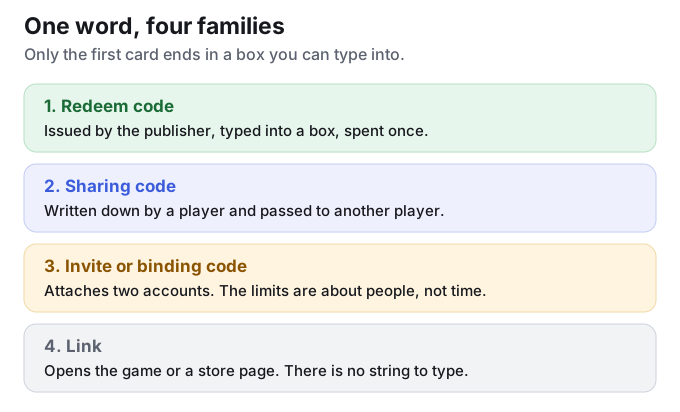
| Family | Who puts it out | Where it goes | What it is not |
|---|---|---|---|
| Redeem code | The publisher, on a channel or in the game | A redemption box, in the game or on the web | Not reusable — the first account to use it spends it |
| Sharing code | Another player | Shared between players, not entered for a reward | Not issued by the publisher and not a gift |
| Invite or binding code | A player, entered by another player | Attaches two accounts to each other | Not a reward drop, and the limits are about people, not time |
| Link | The publisher or another player | Opens the game, or opens a store page | Not a string you type anywhere |
The four rows above are our own split, made from the threads we keep in our source library. It is not a publisher's terminology — no publisher we track sorts its codes this way.
Invite and binding codes: the rule is about people
The third family is the one that looks most like a redeem code and behaves least like one. A redeem code has a window; an invite code has a relationship. The thread we follow for Reverse: 1999 states the two rules in two replies:
“It doesn’t work when you’ve already bound yourself to someone else’s code.”
“Each code can only be used once. That means someone else already used that code. EDIT: You can also only bind to one account.”
So a string from this family can be brand new and still refuse you, because the account is already attached to somebody. Nothing about the string is wrong, and waiting will not help. The same family in Honkai Impact 3rd carries a second label instead — the server it belongs to — which is why the codes in those threads are always posted as a pair:
“107160394GP NA” · “EU server, 209326622AA” · “NA 108999276JY” · “SEA 20816403AA” · “Sea 21040205GW”
Both of those limits are worked through in more detail elsewhere on the site — the binding rule here and the server lock here.
Links: when there is no string at all
The fourth family is the easiest to spot and the most annoying to sort, because the community still calls it codes. In Monopoly GO there is nothing to type: what gets posted is a link, and the whole complaint is about opening it. Three thread titles and a reply, all from the same stretch of the board:
“Link isn’t working??” · “Occasionally the links stop working when you press them”
“Man I got so frustrated when links were not working!! My link and other people’s link!”
“Thank you!!!! The link issue was driving me nuts”
And the boards that carry them are named for the format rather than for a code: “Monopoly GO Free Dice Links - Daily Updated”. If you go looking for a string in that game you will not find one, because the family does not have one.
The four ways a link fails to open, and which of them you can fix, are sorted on the Monopoly GO page.
How to tell which one you are holding
We cannot look at a string and tell you its family. What we can do is list the four questions that sort them, in the order that saves the most time:
- Is there a box to type it in? If no box exists in the game or on the web page, it is not a redeem code. That is the fastest filter of the four.
- Who wrote it down? If the post says “here are my codes” rather than naming a channel the publisher uses, it is a sharing code.
- Does it come with a person attached? If the post is a string plus a server, or a string plus a rule about how many accounts may use it, it is an invite or binding code. Waiting will not clear the refusal.
- Does it open something instead of being entered? Then it is a link, and the problem is the opening, not the code.
If all four answers point at a publisher-issued string, then the family is right and the problem is somewhere else — and that is the point at which our tables become useful, because the remaining question is whether a source still carries it.
What we cannot tell you about this
We do not publish a list of sharing codes or invite codes, and we do not track them. They are not issued by a publisher, they are not single-use in the same way, and there is no source we accept that carries them — so putting them in a table next to redeem codes would make both columns worse. We also cannot tell you what a sharing code is worth to you, because that depends on the game version and on the player who wrote it down.
The quotes above are player posts from our source library, kept as they were written. They are not official statements, and the four-family split is ours, not a publisher’s.
Frequently asked questions
Why does a code someone shared not work in the redemption box?
Because sharing codes and redeem codes are different families that the community calls by the same name. A sharing code is written down by a player; a redeem code is issued by the publisher and typed into a box. Only the second one is meant to go in a box.
Are homestead, layout and arcane codes redeem codes?
No. In AFK Journey they are posted by players for other players, under thread titles like “Some Homestead codes!!” and “New Layout Codes”. Nothing in that family is entered for currency.
Where do people find a wilderness code for Reverse: 1999?
In the thread we follow, the answer given to that exact question was to ask in the game’s Discord, in a channel dedicated to it. It is exchanged between players rather than published as a list, which is why a search turns up nothing usable.
Why does an invite code refuse me even though nobody has used it?
Because the limit is on accounts, not on the string. In the rules quoted in the thread we follow, an account may only be bound to one person’s code and each code may only be used once. If your account is already attached to somebody, a fresh code changes nothing.
Does Monopoly GO have redeem codes?
There is no string to type. What the boards post is a link, which is why the complaints in that community are about links not opening rather than about codes being dead.
How do I know a code is the kind your tables cover?
It is a publisher-issued string, a source on our list still carries it, and it goes into a redemption box — in the game or on the web. Our game pages give each one a status and the last date a source carried it, so the answer is on the row rather than in a paragraph.